Einbürgerungstest
Staatssymbole: Flagge, Wappen und Hymne
The name of the state
Germany's full name is "Bundesrepublik Deutschland" (Federal Republic of Germany). Both parts of the name have a meaning. "Federal" means that the state is made up of 16 Länder (federal states). "Republic" means that there is no king or emperor. At the top is an elected person, the Federal President (Bundespräsidentin or Bundespräsident). The name has existed since 1949, and it is also written in the Grundgesetz (Basic Law, the German constitution).
A little over 83 million people live in Germany (as of 2026). In the test, "84 Millionen" is therefore the best answer. No other country in the European Union has as many inhabitants.
The flag
The federal flag is black, red and gold. This is set out in Article 22 of the Grundgesetz. The colours are older than the state. As early as 1832, people at the Hambach Festival (Hambacher Fest) carried black, red and gold flags. They wanted a united Germany with civil liberties. Today you see the flag on public buildings, during state visits and at football matches of the national team.
The coat of arms
The coat of arms of the Federal Republic is the federal eagle (Bundesadler). It is black, has a red beak and red claws, and stands on a golden yellow background. The eagle has been a sign of German rulers since the Middle Ages. You see it on the passport, on euro coins and in the plenary hall of the Bundestag.
With pictures, you have to look carefully. The black cross with a white border is the emblem of the Bundeswehr (German armed forces), not of the state. Hammer and compass in a wreath of wheat were the coat of arms of the GDR. The sign made of the Greek letters X and P is a Christian symbol for Christ.
The national anthem
The national anthem is the third verse of the "Lied der Deutschen" (Song of the Germans). Hoffmann von Fallersleben wrote the text in 1841. The melody is by Joseph Haydn. Since 1991, officially only the third verse is the anthem. It begins with "Einigkeit und Recht und Freiheit für das deutsche Vaterland" (Unity and justice and freedom for the German fatherland).
Memory aid
Black, red and gold is the colour of the freedom movement of 1832 and today the flag of the Federal Republic. Black, white and red belongs to the German Empire, the time of the emperors. For the coat of arms, look at the animal. The eagle stands for the Federal Republic. Hammer and compass without an animal stand for the GDR.
Common traps
- "Freude schöner Götterfunken" or "Völker, hört die Signale": The first is the European anthem, with a melody by Beethoven. The second is the "Internationale", an old song of the workers' movement. Neither is the German anthem.
- "Deutschland einig Vaterland": These words are in the anthem of the GDR.
- "rot-weiß-schwarz" or "schwarz-gelb-rot": Black, white and red was the flag of the German Empire. Black, yellow and red in that order is the flag of Belgium.
- "Bundesstaat Deutschland": Germany is a federal state, but its official name is "Bundesrepublik Deutschland".
Related topics: "Grundgesetz und Grundrechte", "Wappen der Bundesländer" and "Flaggen der Bundesländer".
Question allgemein-021
Welches ist das Wappen der Bundesrepublik Deutschland?
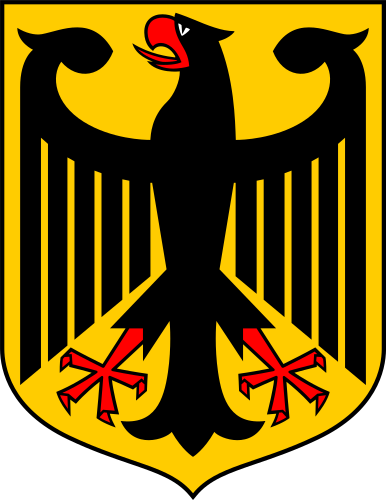 (correct answer)
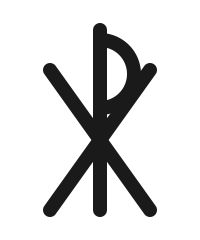

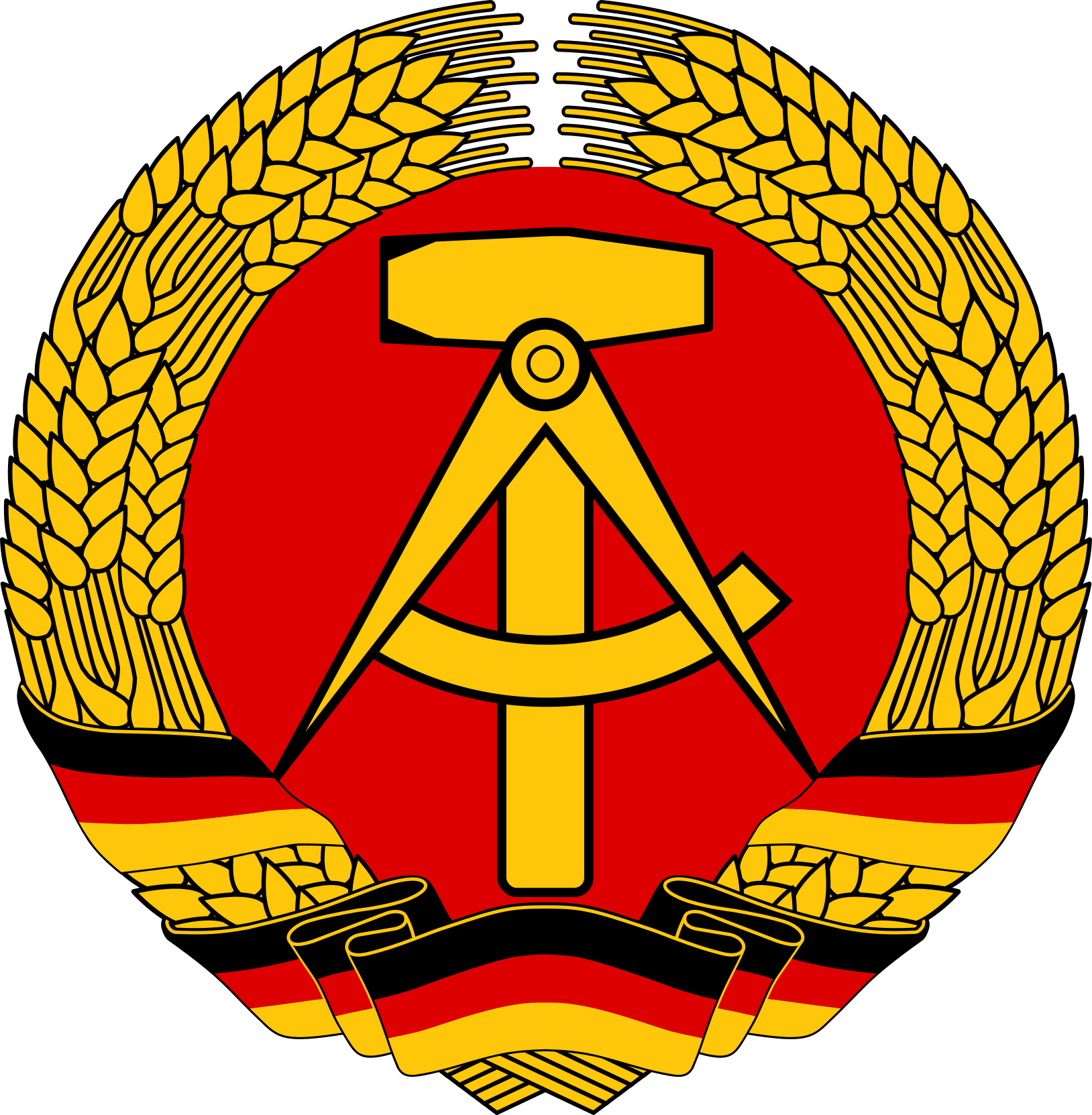
Explanation
The coat of arms of the Federal Republic is the Bundesadler (federal eagle), a black eagle on a golden yellow background. You can see it, for example, in the Bundestag and on the German passport.
- „Bild 2“: Shows the Christogram, a Christian symbol made of the Greek letters Chi and Rho. It is not a state coat of arms.
- „Bild 3“: Shows the Iron Cross. It is the emblem of the Bundeswehr (German armed forces), not the coat of arms of the state.
- „Bild 4“: Shows a hammer, a compass and a wreath of wheat. That was the coat of arms of the DDR (East Germany) until 1990.
Question allgemein-029
Welches Tier ist das Wappentier der Bundesrepublik Deutschland?
- Löwe
- Adler(correct answer)
- Bär
- Pferd
Explanation
The eagle has been a symbol of German rulers since the Middle Ages. Today the black Bundesadler (federal eagle) is the heraldic animal of the Federal Republic, and you can see it, for example, in the Bundestag.
- „Löwe“: Appears in the coats of arms of some federal states, for example Bavaria and Hesse, but not in the federal coat of arms.
- „Bär“: Is the heraldic animal of Berlin, not of all of Germany.
- „Pferd“: Appears in the coat of arms of Lower Saxony, not in the coat of arms of the Federal Republic.
Question allgemein-040
Mit welchen Worten beginnt die deutsche Nationalhymne?
- Völker, hört die Signale …
- Einigkeit und Recht und Freiheit …(correct answer)
- Freude schöner Götterfunken …
- Deutschland einig Vaterland …
Explanation
The national anthem is the third verse of the „Lied der Deutschen“ (Song of the Germans), which Hoffmann von Fallersleben wrote in 1841. This verse begins with „Einigkeit und Recht und Freiheit“ (Unity and justice and freedom).
- „Völker, hört die Signale …“: Is the beginning of „The Internationale“, a song of the workers' movement.
- „Freude schöner Götterfunken …“: Comes from Schiller's „Ode to Joy“. Beethoven's melody is the anthem of the European Union.
- „Deutschland einig Vaterland …“: Comes from the anthem of the DDR (East Germany), „Auferstanden aus Ruinen“ (Risen from ruins).
Question allgemein-212
Wie heißt Deutschland mit vollem Namen?
- Bundesstaat Deutschland
- Bundesländer Deutschland
- Bundesrepublik Deutschland(correct answer)
- Bundesbezirk Deutschland
Explanation
Germany is a federation of 16 federal states and a republic, so it has no king. That is why it has been called „Bundesrepublik Deutschland“ (Federal Republic of Germany) since 1949, and that is also what the Grundgesetz (constitution) says.
- „Bundesstaat Deutschland“: Germany is a federal state, but that is not its official name. The name contains „Republik“.
- „Bundesländer Deutschland“: Bundesländer are the 16 federal states of Germany, for example Bavaria. That is not a name for the country.
- „Bundesbezirk Deutschland“: This name does not exist. Germany has federal states, but no federal districts.
Question allgemein-213
Wie viele Einwohner hat Deutschland?
- 70 Millionen
- 78 Millionen
- 84 Millionen(correct answer)
- 90 Millionen
Explanation
According to the Statistisches Bundesamt (Federal Statistical Office), a little over 83 million people live in Germany today. Of the answers, 84 million is the closest. Germany has the most inhabitants in the European Union.
- „70 Millionen“ and „78 Millionen“: That is too few. The number has been above 80 million for many years.
- „90 Millionen“: That is too many. Germany has never had that many inhabitants.
Question allgemein-214
Welche Farben hat die deutsche Flagge?
- schwarz-rot-gold(correct answer)
- rot-weiß-schwarz
- schwarz-rot-grün
- schwarz-gelb-rot
Explanation
Article 22 of the Grundgesetz (constitution) states that the federal flag is black-red-gold. Since the Hambacher Fest (Hambach Festival) of 1832, these colours have stood for unity and freedom.
- „rot-weiß-schwarz“: Black, white and red were the colours of the flag of the German Empire from 1871, not of today's flag.
- „schwarz-rot-grün“: Green is not in the German flag. The third colour is gold.
- „schwarz-gelb-rot“: These are the colours of the Belgian flag. In the German flag, red is in the middle and gold at the bottom.