Einbürgerungstest
Die Bundestagswahl
What is elected
In the federal election, citizens elect the parliament for the whole of Germany, the Bundestag [federal parliament]. They do not elect the chancellor directly with it. The Bundestag elects the chancellor afterwards. The federal president and the Landtage [state parliaments] are not elected in this election either.
Under Article 39 of the Grundgesetz [Basic Law] the Bundestag is elected for four years. This period is called the Wahlperiode [legislative term]. An earlier election only happens if the federal president dissolves the Bundestag. This last happened at the end of 2024. That is why there was an early election on 23 February 2025. The next regular election is expected in 2029 (as of 2026).
Who may vote
Anyone who has German citizenship and is at least 18 years old on election day may vote. This is set out in Article 38 of the Basic Law and in the Bundeswahlgesetz [Federal Electoral Act]. So it is not enough to live in Germany, not even for many years. Citizens of other EU countries may help elect the local councils and the European Parliament in Germany, but not the Bundestag.
It used to be different. In Prussia a three-class franchise applied until 1918. The vote of rich citizens counted for more there. Women in Germany have only been allowed to vote since 1918. Today every vote counts the same.
Two votes on one ballot
Every voter has two votes. That is why the system is called Mehrheits- und Verhältniswahlrecht (majority and proportional voting). It is a mix of both.
- Erststimme (first vote, left): With it you elect a person in your own constituency. There are 299 constituencies. Whoever has the most votes there wins the constituency. This is majority voting.
- Zweitstimme (second vote, right): With it you elect a party. The seats in the Bundestag are shared out according to the share of second votes. This is proportional representation. A party with 30 percent gets roughly 30 percent of the seats. So the party with the most votes wins the election. There is no separate vote for the candidates for chancellor.
A ballot with exactly one cross on the left and one cross on the right is valid. Anyone who makes two crosses in one column makes that vote invalid. Each of the two votes is checked separately.
Since the reform of electoral law the Bundestag has 630 seats (as of 2026). A constituency winner only gets the seat if their party has enough second votes for it.
The 5% threshold
A party needs at least 5 percent of the second votes, otherwise it normally gets no seats. An exception applies to parties that win at least three constituencies. The Bundesverfassungsgericht [Federal Constitutional Court] decided this in 2024 (as of 2026). The threshold has a reason from history. In the Weimar Republic a great many small parties sat in the Reichstag. It was hard to find a majority for a government, and governments often did not last long.
Memory aid
Remember three numbers, 18, 4 and 5. Vote at 18, every 4 years, into parliament from 5 percent. On the ballot the person is on the left and the party on the right. The right-hand vote decides the seats.
Common traps
- 16 years: From 16 you may vote in local elections in many federal states and, since 2024, in the European election. For the Bundestag the age is 18.
- 5 years: That is the length of the federal president's term and the legislative term of most Landtage. The Bundestag is elected for 4 years.
- "in der Bundesrepublik Deutschland wohnt" (lives in Germany): Living there is not enough. You need German citizenship.
- "mehr Direktkandidaten ziehen ein" (more constituency candidates get in): Constituency candidates win with the first vote. The second votes decide how many seats a party gets in total.
Related topics: Wahlgrundsätze und Wahlrecht, Der Deutsche Bundestag, Politische Parteien.
Question allgemein-093
Je mehr "Zweitstimmen" eine Partei bei einer Bundestagswahl bekommt, desto …
- weniger Erststimmen kann sie haben.
- mehr Direktkandidaten der Partei ziehen ins Parlament ein.
- größer ist das Risiko, eine Koalition bilden zu müssen.
- mehr Sitze erhält die Partei im Parlament.(correct answer)
Explanation
The second vote is for a party. The seats in the Bundestag are shared out according to the share of second votes. So a party with 30 percent gets roughly 30 percent of the seats.
- „weniger Erststimmen kann sie haben.“: First and second votes are counted separately. One has no effect on the other.
- „mehr Direktkandidaten der Partei ziehen ins …“: The first vote decides who wins a constituency. The second vote decides how many seats the party gets in total.
- „größer ist das Risiko, eine Koalition …“: With more seats a party tends to need fewer partners. A coalition is needed when no party has a majority on its own.
Question allgemein-094
Ab welchem Alter darf man in Deutschland an der Wahl zum Deutschen Bundestag teilnehmen?
- 16
- 18(correct answer)
- 21
- 23
Explanation
Article 38 of the Grundgesetz (Basic Law) says that you may vote in the Bundestag election from the age of 18. Anyone who is 18 on election day and has German citizenship may vote.
- Nr. 16: From 16 you may vote in some states in local or state elections, and in the European election. For the Bundestag the age is 18.
- Nr. 21: Until 1970 the voting age was 21. Since then it has been 18.
- Nr. 23: No election in Germany has an age limit of 23.
Question allgemein-107
Für wie viele Jahre wird der Bundestag in Deutschland gewählt?
- 2 Jahre
- 4 Jahre(correct answer)
- 6 Jahre
- 8 Jahre
Explanation
Article 39 of the Grundgesetz (the German constitution) states that the Bundestag (federal parliament) is elected for four years. This period is called the Wahlperiode (legislative term). After it, citizens elect a new Bundestag.
- „2 Jahre“, „6 Jahre“ and „8 Jahre“: Article 39 of the Grundgesetz names four years, not two, six or eight.
Question allgemein-108
Bei einer Bundestagswahl in Deutschland darf jede/jeder wählen, die/der …
- in der Bundesrepublik Deutschland wohnt und wählen möchte.
- Bürgerin/Bürger der Bundesrepublik Deutschland ist und mindestens 18 Jahre alt ist.(correct answer)
- seit mindestens 3 Jahren in der Bundesrepublik Deutschland lebt.
- Bürgerin/Bürger der Bundesrepublik Deutschland ist und mindestens 21 Jahre alt ist.
Explanation
Article 38 of the Grundgesetz says that you may vote from the age of 18. The Bundeswahlgesetz (federal electoral law) also requires German citizenship.
- „in der Bundesrepublik Deutschland wohnt und …“: Living in Germany is not enough. Without German citizenship you may not vote in the Bundestag election.
- „seit mindestens 3 Jahren in der …“: The time spent in Germany does not decide it. Even after many years you need German citizenship.
- „Bürgerin/Bürger der Bundesrepublik Deutschland ist und …“: The voting age was 21 only until 1970. Since then it has been 18 years.
Question allgemein-109
Wie oft gibt es normalerweise Bundestagswahlen in Deutschland?
- alle drei Jahre
- alle vier Jahre(correct answer)
- alle fünf Jahre
- alle sechs Jahre
Explanation
According to Article 39 of the Grundgesetz, the Bundestag is elected for four years. An earlier election only happens when the Bundespräsident (federal president) dissolves the Bundestag, as most recently in 2025.
- „alle drei Jahre“ and „alle sechs Jahre“: The Grundgesetz sets four years for the Bundestag, no other length.
- „alle fünf Jahre“: Five years apply, for example, to the Bundespräsident and the European Parliament, not to the Bundestag.
Question allgemein-110
Für wie viele Jahre wird der Bundestag in Deutschland gewählt?
- 2 Jahre
- 3 Jahre
- 4 Jahre(correct answer)
- 5 Jahre
Explanation
Article 39 of the Grundgesetz (the German constitution) sets the term of the Bundestag (federal parliament) at four years. After that, the next Bundestag election takes place.
- „2 Jahre“ and „3 Jahre“: The term is not that short. The Grundgesetz names four years.
- „5 Jahre“: Five years apply to the Bundespräsident (federal president) and to most Landtage (state parliaments), not to the Bundestag.
Question allgemein-113
Wahlen in Deutschland gewinnt die Partei, die …
- die meisten Stimmen bekommt.(correct answer)
- die meisten Männer mehrheitlich gewählt haben.
- die meisten Stimmen bei den Arbeiterinnen/Arbeitern bekommen hat.
- die meisten Erststimmen für ihre Kanzlerkandidatin/ihren Kanzlerkandidaten erhalten hat.
Explanation
In an election every vote has the same weight, as Article 38 of the Grundgesetz (the German constitution) says. That is why the party that gets the most votes overall wins.
- „die meisten Männer mehrheitlich gewählt haben.“ and „die meisten Stimmen bei den Arbeiterinnen/Arbeitern …“: All votes count the same, whether from women or men and whatever the job. Nobody counts one group's votes separately.
- „die meisten Erststimmen für ihre Kanzlerkandidatin/ihren …“: The chancellor is elected by the Bundestag. With the Erststimme (first vote) you only choose a person in your own constituency.
Question allgemein-117
Wie viel Prozent der Zweitstimmen müssen Parteien mindestens bekommen, um in den Deutschen Bundestag gewählt zu werden?
- 3%
- 4%
- 5%(correct answer)
- 6%
Explanation
The Bundeswahlgesetz (federal electoral law) requires at least 5 percent of the Zweitstimmen (second votes) for a party to get seats in the Bundestag. This is meant to keep too many very small parties out of parliament.
- „3%“ and „4%“: With less than 5 percent of the second votes a party normally does not get into the Bundestag.
- „6%“: The limit is 5 percent. A party with exactly 5 percent is therefore already in.
Question allgemein-120
Das Wahlsystem in Deutschland ist ein …
- Zensuswahlrecht.
- Dreiklassenwahlrecht.
- Mehrheits- und Verhältniswahlrecht.(correct answer)
- allgemeines Männerwahlrecht.
Explanation
With the Erststimme (first vote) you choose a person in your constituency. There, whoever has the most votes counts. That is the majority vote. With the Zweitstimme (second vote) you choose a party. The seats in the Bundestag are shared out according to its share. That is proportional representation.
- „Zensuswahlrecht.“: Under a census suffrage, the right to vote depends on property or taxes. In Germany every vote has the same weight.
- „Dreiklassenwahlrecht.“: This existed in Prussia from 1849 to 1918. Rich citizens had more weight than poor ones back then.
- „allgemeines Männerwahlrecht.“: Women have been allowed to vote in Germany since 1918. Today the right to vote applies to all adults with German citizenship.
Question allgemein-121
Eine Partei möchte in den Deutschen Bundestag. Sie muss aber einen Mindestanteil an Wählerstimmen haben. Das heißt …
- 5%-Hürde.(correct answer)
- Zulassungsgrenze.
- Basiswert.
- Richtlinie.
Explanation
Under the Bundeswahlgesetz (federal electoral law) a party needs at least 5 percent of the Zweitstimmen (second votes) to get seats in the Bundestag. This limit is like a hurdle in sport that a party has to jump over.
- „Zulassungsgrenze.“ and „Basiswert.“: That is not what this limit is called. Its name is 5%-Hürde (5 percent hurdle).
- „Richtlinie.“: A Richtlinie is a general rule, for example from the EU. It has nothing to do with the minimum share of votes.
Question allgemein-123
Was ist in Deutschland die "5%-Hürde"?
- Abstimmungsregelung im Bundestag für kleine Parteien
- Anwesenheitskontrolle im Bundestag für Abstimmungen
- Mindestanteil an Wählerstimmen, um ins Parlament zu kommen(correct answer)
- Anwesenheitskontrolle im Bundesrat für Abstimmungen
Explanation
In the Bundestag election a party needs at least 5 percent of the Zweitstimmen (second votes), otherwise it normally gets no seats. This is set out in the Bundeswahlgesetz (federal electoral law) and applies to the election, not to votes in parliament.
- „Abstimmungsregelung im Bundestag für kleine Parteien“: The hurdle decides who gets into the Bundestag. In votes inside the Bundestag every member's vote then counts the same.
- „Anwesenheitskontrolle im Bundestag für Abstimmungen“: The hurdle has nothing to do with attendance. It concerns the voters' votes in the election.
- „Anwesenheitskontrolle im Bundesrat für Abstimmungen“: The Bundesrat (federal council) is not elected at all. Its members are sent by the state governments, and there is no 5 percent hurdle there.
Question allgemein-124
Die Bundestagswahl in Deutschland ist die Wahl …
- der Bundeskanzlerin/des Bundeskanzlers.
- der Parlamente der Länder.
- des Parlaments für Deutschland.(correct answer)
- der Bundespräsidentin/des Bundespräsidenten.
Explanation
In the Bundestag election citizens elect the members of the Bundestag, the parliament for all of Germany. The Bundestag then makes the federal laws and elects the chancellor.
- „der Bundeskanzlerin/des Bundeskanzlers.“: Citizens do not elect the chancellor directly. The Bundestag elects the chancellor under Article 63 of the Grundgesetz (the German constitution).
- „der Parlamente der Länder.“: The state parliaments are called Landtage. They are elected in separate Landtag elections.
- „der Bundespräsidentin/des Bundespräsidenten.“: The Bundespräsident (federal president) is elected by the Bundesversammlung (federal convention). It consists of the members of the Bundestag and the same number of delegates from the states.
Question allgemein-127
Warum gibt es die 5%-Hürde im Wahlgesetz der Bundesrepublik Deutschland? Es gibt sie, weil …
- die Programme von vielen kleinen Parteien viele Gemeinsamkeiten haben.
- die Bürgerinnen und Bürger bei vielen kleinen Parteien die Orientierung verlieren können.
- viele kleine Parteien die Regierungsbildung erschweren.(correct answer)
- die kleinen Parteien nicht so viel Geld haben, um die Politikerinnen und Politiker zu bezahlen.
Explanation
When a great many small parties sit in parliament, it is hard to find a majority for a government. In the Weimar Republic there were many parties in the Reichstag, and governments often did not last long.
- „die Programme von vielen kleinen Parteien …“: What the programmes say does not matter for the hurdle. It applies to every party in the same way.
- „die Bürgerinnen und Bürger bei vielen …“: Small parties still appear on the ballot. The hurdle concerns parliament, not the voters' choice.
- „die kleinen Parteien nicht so viel …“: Members of parliament are paid by the state, not by their party. A party's money is therefore not a reason for the hurdle.
Question allgemein-130
Welcher Stimmzettel wäre bei einer Bundestagswahl gültig?
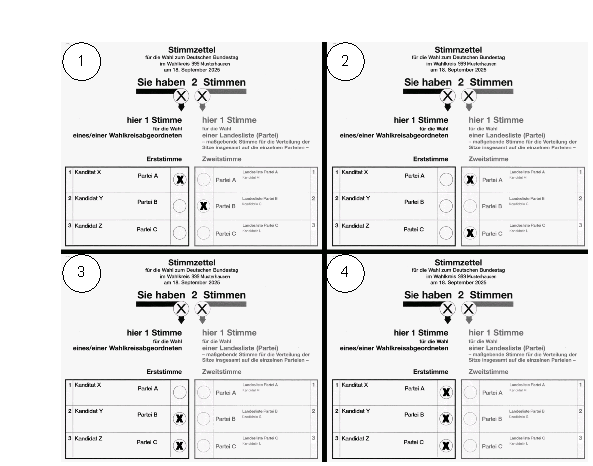
- 1(correct answer)
- 2
- 3
- 4
Explanation
Ballot 1 has exactly one cross for the Erststimme (first vote) and one for the Zweitstimme (second vote). Under the Bundeswahlgesetz (federal electoral law) each of the two votes is checked on its own, and here both are valid.
- Nr. 2: The first vote is missing, and two crosses for the second vote make it invalid.
- Nr. 3 and Nr. 4: Here there are several crosses for the first vote and none for the second vote. The first vote is therefore invalid, and the second vote is missing.