Einbürgerungstest
Der Deutsche Bundestag
What the Bundestag is
The Bundestag [federal parliament] is the parliament for the whole of Germany. Since 1999 it has worked in Berlin in the Reichstag building. The building has columns at the entrance, four corner towers and a dome made of glass. Above the entrance it says "Dem deutschen Volke" (To the German people). Visitors can register and climb up into the dome.
The members of the Bundestag are called Abgeordnete [members of parliament]. The people entitled to vote elect them, normally every four years. The Bundestag has 630 seats (as of 2026). Under Article 38 of the Grundgesetz [Basic Law], the members represent the whole people. They are not bound by any instructions and follow their conscience.
The 16 federal states have their own parliaments, the Landtage [state parliaments]. The Bundestag is responsible for the laws that apply in the whole of Germany. The Volkskammer [People's Chamber] was the parliament of the GDR. The Bundesversammlung [Federal Convention] meets only to elect the head of state.
The tasks
- Passing laws: Drafts come from the Bundesregierung [federal government], from the Bundesrat [federal council] or from the Bundestag itself. The members discuss them in committees, often change them and then vote. For many laws the Bundesrat must also agree afterwards.
- Electing the federal chancellor: The Bundestag does this after every election.
- Keeping a check on the government: Members ask the government questions and can set up committees of inquiry.
- Deciding on the budget: Every year the Bundestag decides what the federal state spends its money on.
The Bundestag does not form the Bundeskabinett [federal cabinet], however. The cabinet is the federal government, that is the chancellor and the ministers. The chancellor chooses the ministers. The federal president appoints them.
Parliamentary groups, government and opposition
The members of one party together form a Fraktion [parliamentary group]. This needs at least five percent of the seats. CDU and CSU form a joint group. The groups with a majority usually form the government together, a coalition. All other members are the opposition. It keeps a check on the government, criticises its plans and makes its own proposals.
If a member changes to another group, they keep their seat. If the government has only a narrow majority, it can lose its majority this way.
President and plenary hall
The Bundestag elects its president from among its own members. By long tradition this person comes from the strongest group. Since 2025 Julia Klöckner of the CDU has been President of the Bundestag (as of 2026). She chairs the sessions. In the plenary hall, the large hall for the sessions, hangs a large Bundesadler [federal eagle]. Because of its round shape it is also called the "fat hen".
Memory aid: The people elect the Bundestag. The Bundestag elects the chancellor. The chancellor chooses the ministers.
Common traps
- "die Regierung" passes laws: The government writes many drafts. But only parliament may pass them.
- Opposition as "die Fraktion mit den meisten Abgeordneten": The largest group usually sits in the government. The opposition are those who do not govern.
- "die/der älteste Abgeordnete" becomes president: The first session after the election is only opened by the Alterspräsident [senior president]. Today that is the member who has sat in the Bundestag the longest. After that, someone from the strongest group is usually elected.
- "das Bundeskabinett zu bilden" as a task: It sounds right, but it is the chancellor's job.
Related topics: Die Bundestagswahl, Bundesregierung und Bundeskanzler, Bundesrat und Föderalismus.
Question allgemein-013
Im Parlament steht der Begriff "Opposition" für …
- die regierenden Parteien.
- die Fraktion mit den meisten Abgeordneten.
- alle Parteien, die bei der letzten Wahl die 5%-Hürde erreichen konnten.
- alle Abgeordneten, die nicht zu der Regierungspartei/den Regierungsparteien gehören.(correct answer)
Explanation
The opposition includes all members of parliament whose party is not in government. Its task is to check the government and to make its own proposals.
- „die regierenden Parteien.“: That is the opposite. The governing parties form the government, and the opposition stands against it.
- „die Fraktion mit den meisten Abgeordneten.“: The largest parliamentary group usually forms the government. Then it is exactly not the opposition.
- „alle Parteien, die bei der letzten …“: The governing parties also cleared the 5% threshold. So the threshold says nothing about who is in opposition.
Question allgemein-028
Wer wählt in Deutschland die Abgeordneten zum Bundestag?
- das Militär
- die Wirtschaft
- das wahlberechtigte Volk(correct answer)
- die Verwaltung
Explanation
Members of parliament get their seat through elections. All German citizens aged 18 and over may vote. The election is free and secret, as Article 38 of the Grundgesetz says.
- „das Militär“, „die Wirtschaft“ and „die Verwaltung“: The military, companies and public offices have no vote of their own in the election. The people working there vote only as individual citizens.
Question allgemein-042
Wer beschließt in Deutschland ein neues Gesetz?
- die Regierung
- das Parlament(correct answer)
- die Gerichte
- die Polizei
Explanation
In Germany laws are passed by parliament, at the federal level that is the Bundestag. For many laws the Bundesrat (federal council), where the federal states are represented, must also agree.
- „die Regierung“: The government often proposes new laws. But it may not pass them itself.
- „die Gerichte“: Courts apply laws and review them. They do not pass new laws, as the separation of powers requires.
- „die Polizei“: The police make sure that laws are obeyed. They do not make laws.
Question allgemein-055
Was zeigt dieses Bild?
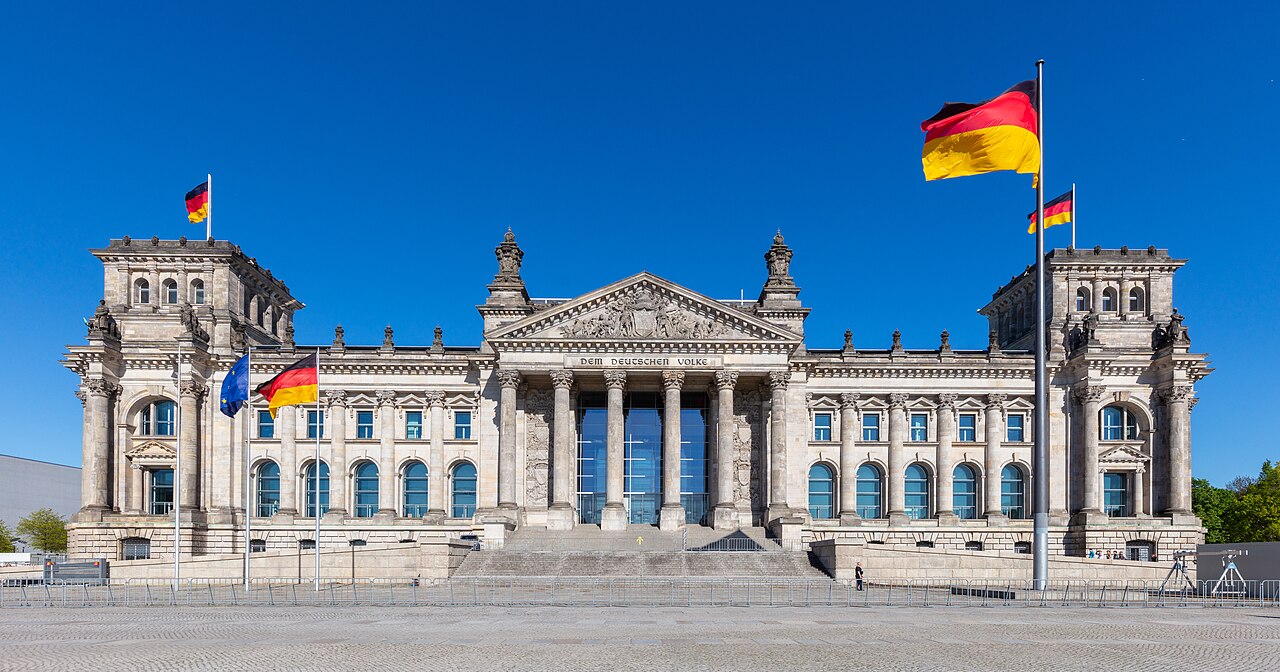
Foto: Diego Delso, Wikimedia Commons, CC BY-SA 4.0 - den Bundestagssitz in Berlin(correct answer)
- das Bundesverfassungsgericht in Karlsruhe
- das Bundesratsgebäude in Berlin
- das Bundeskanzleramt in Berlin
Explanation
The picture shows the Reichstag building with its columns and four corner towers. Above the entrance it says "Dem deutschen Volke" (To the German people). Since 1999 the Bundestag, the parliament for all of Germany, has worked here.
- „das Bundesverfassungsgericht in Karlsruhe“: This court is in Karlsruhe, not in Berlin. It is a flat, modern glass building.
- „das Bundesratsgebäude in Berlin“: The Bundesrat sits in the former Prussian House of Lords on Leipziger Straße. That is a different building.
- „das Bundeskanzleramt in Berlin“: The Chancellery is a large modern building near the Reichstag, without old columns and corner towers.
Question allgemein-057
Wer wird meistens zur Präsidentin/zum Präsidenten des Deutschen Bundestages gewählt?
- die/der älteste Abgeordnete im Parlament
- die Ministerpräsidentin/der Ministerpräsident des größten Bundeslandes
- eine ehemalige Bundeskanzlerin/ein ehemaliger Bundeskanzler
- eine Abgeordnete/ein Abgeordneter der stärksten Fraktion(correct answer)
Explanation
The Bundestag elects its President from among its own members. By long tradition the largest parliamentary group, that is the strongest group of members, proposes someone from its own ranks.
- „die/der älteste Abgeordnete im Parlament“: The senior member only chairs the first sitting until the President is elected. Since 2017 this is whoever has served longest in the Bundestag.
- „die Ministerpräsidentin/der Ministerpräsident des größten Bundeslandes“: Minister-presidents lead a state government. They are usually not members of the Bundestag.
- „eine ehemalige Bundeskanzlerin/ein ehemaliger Bundeskanzler“: There is no such rule. A current member of parliament is elected.
Question allgemein-065
Es gehört nicht zu den Aufgaben des Deutschen Bundestages, …
- Gesetze zu entwerfen.
- die Bundesregierung zu kontrollieren.
- die Bundeskanzlerin/den Bundeskanzler zu wählen.
- das Bundeskabinett zu bilden.(correct answer)
Explanation
The Bundeskabinett (federal cabinet) is the federal government. The Bundestag only elects the Federal Chancellor. The Chancellor then chooses the ministers, and the Federal President appoints them.
- „Gesetze zu entwerfen.“: Really is a task. Members of parliament can introduce draft laws themselves and debate them in the Bundestag.
- „die Bundesregierung zu kontrollieren.“: Really is a task. The Bundestag questions the government and checks its work and its money.
- „die Bundeskanzlerin/den Bundeskanzler zu wählen.“: Really is a task. Under Article 63 of the Grundgesetz the Bundestag elects the Chancellor.
Question allgemein-074
Wie heißt das Parlament für ganz Deutschland?
- Bundesversammlung
- Volkskammer
- Bundestag(correct answer)
- Bundesgerichtshof
Explanation
The Bundestag is the parliament of the federation, meaning all of Germany. Citizens elect it every four years. In addition, the 16 federal states have their own parliaments, the Landtage (state parliaments).
- „Bundesversammlung“: It only meets to elect the Federal President.
- „Volkskammer“: That was the name of the GDR's parliament until 1990. Today the Volkskammer no longer exists.
- „Bundesgerichtshof“: That is a high court in Karlsruhe, not a parliament. It decides on criminal cases, for example.
Question allgemein-088
Die parlamentarische Opposition im Deutschen Bundestag …
- kontrolliert die Regierung.(correct answer)
- entscheidet, wer Bundesministerin/Bundesminister wird.
- bestimmt, wer im Bundesrat sitzt.
- schlägt die Regierungschefinnen/Regierungschefs der Länder vor.
Explanation
The opposition is the parties that do not govern. Its most important task is to check the government. In the Bundestag it asks the government questions and criticises its plans.
- „entscheidet, wer Bundesministerin/Bundesminister wird.“: The Federal Chancellor proposes the ministers. The Federal President appoints them.
- „bestimmt, wer im Bundesrat sitzt.“: The state governments send their members to the Bundesrat. The opposition in the Bundestag does not decide on this.
- „schlägt die Regierungschefinnen/Regierungschefs der Länder vor.“: The heads of government of the states are elected by the Landtag (state parliament) of each state.
Question allgemein-089
Wie nennt man in Deutschland die Vereinigung von Abgeordneten einer Partei im Parlament?
- Verband
- Ältestenrat
- Fraktion(correct answer)
- Opposition
Explanation
A Fraktion (parliamentary group) is the group of a party's members in parliament. In the Bundestag it needs at least five percent of the seats. Its members discuss things together and often vote together.
- „Verband“: An association represents interests outside parliament, for example a trade union or a sports association.
- „Ältestenrat“: The Council of Elders helps the President plan the work of the Bundestag. Members of all parliamentary groups sit on it.
- „Opposition“: That is all members of parliament whose party does not govern. They often come from several parties.
Question allgemein-098
Wenn Abgeordnete im Deutschen Bundestag ihre Fraktion wechseln, …
- dürfen sie nicht mehr an den Sitzungen des Parlaments teilnehmen.
- kann die Regierung ihre Mehrheit verlieren.(correct answer)
- muss die Bundespräsidentin/der Bundespräsident zuvor ihr/sein Einverständnis geben.
- dürfen die Wählerinnen/Wähler dieser Abgeordneten noch einmal wählen.
Explanation
A government needs a majority of the votes in the Bundestag. If some members switch from a governing parliamentary group to another group, this majority can be lost.
- „dürfen sie nicht mehr an den …“: They keep their seat. Under Article 38 of the Grundgesetz members of parliament are free and bound only by their conscience.
- „muss die Bundespräsidentin/der Bundespräsident zuvor ihr/sein …“: Members of parliament need no permission to switch. They decide this themselves.
- „dürfen die Wählerinnen/Wähler dieser Abgeordneten noch …“: There is no new election for this. The seat is valid until the next Bundestag election.
Question allgemein-128
Parlamentsmitglieder, die von den Bürgerinnen und Bürgern gewählt werden, nennt man …
- Abgeordnete.(correct answer)
- Kanzlerinnen/Kanzler.
- Botschafterinnen/Botschafter.
- Ministerpräsidentinnen/Ministerpräsidenten.
Explanation
The members of parliament are called Abgeordnete (members of parliament). Citizens elect them, for the Bundestag every four years. There the members represent the whole people.
- „Kanzlerinnen/Kanzler.“: The Bundestag elects the Federal Chancellor. Citizens do not elect the Chancellor directly.
- „Botschafterinnen/Botschafter.“: They represent Germany abroad. They are appointed, not elected by the people.
- „Ministerpräsidentinnen/Ministerpräsidenten.“: They lead the government of a federal state. They are elected by the Landtag, not directly by the people.
Question allgemein-216
Welches Symbol ist im Plenarsaal des Deutschen Bundestages zu sehen?
- der Bundesadler(correct answer)
- die Fahne der Stadt Berlin
- der Reichsadler
- die Reichskrone
Explanation
A large federal eagle hangs on the wall behind the speaker's lectern. It is the heraldic animal of the Federal Republic of Germany. Because of its round shape many people also call it the "fat hen".
- „die Fahne der Stadt Berlin“: Berlin's coat of arms shows a bear. The Bundestag is the parliament for all of Germany, not for a single city.
- „der Reichsadler“: The imperial eagle was the symbol of the former German Reich. The Federal Republic has its own coat of arms.
- „die Reichskrone“: The crown belonged to the emperors in the Middle Ages. Today it is kept in Vienna, not in the Bundestag.