Einbürgerungstest
Bayern
3 of the 10 questions about Bayern (Bavaria) come up in the test. They ask about the state's location, its symbols and its politics.
Location and structure
Bayern is the largest federal state. It lies in the south and south-east of Germany. Its neighbours are Baden-Württemberg in the west, Hessen and Thüringen in the north and Sachsen in the north-east. Bayern also borders Austria and the Czech Republic. The state capital is München (Munich). Nürnberg, Regensburg and Ingolstadt are large cities, but not the capital. Bayern has 7 administrative regions (Regierungsbezirke) and 71 districts (Landkreise), for example the district of Altötting in Upper Bavaria.
Colours and coat of arms
Bayern calls itself a Freistaat (free state). The state colours are white and blue (Weiß und Blau). This is written in Article 1 of the Bavarian constitution. The best-known symbol is the white and blue diamond pattern. The small state coat of arms is a shield with these diamonds and a crown on top. The large state coat of arms also shows lions.
State parliament and government
The Bavarian state parliament (Landtag) is elected for 5 years. The government is called the Staatsregierung. Its head is called the Ministerpräsident or Ministerpräsidentin (minister-president). Bayern has, for example, a ministry of the interior, a ministry of justice and a ministry of finance. There is no foreign ministry, because relations with other countries are the job of the federal government (Bund).
In local elections (Kommunalwahlen), that is, elections for the municipal council and the district council, you can vote in Bayern from age 18. You can get information on political topics from the Landeszentrale für politische Bildung (state agency for civic education). Its official name is Bayerische Landeszentrale für politische Bildungsarbeit.
Question bayern-01
Welches Wappen gehört zum Freistaat Bayern?
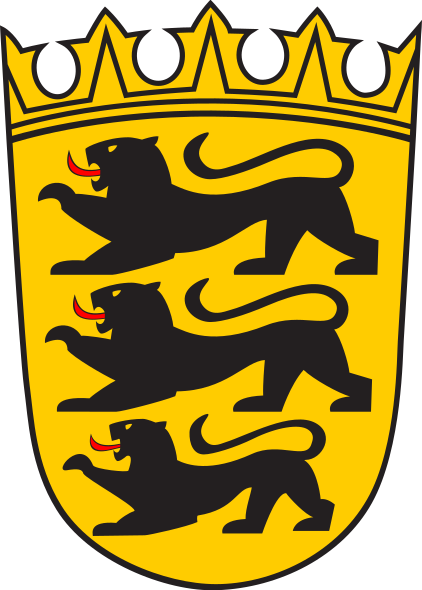
 (correct answer)
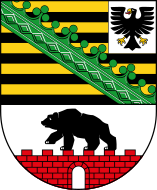
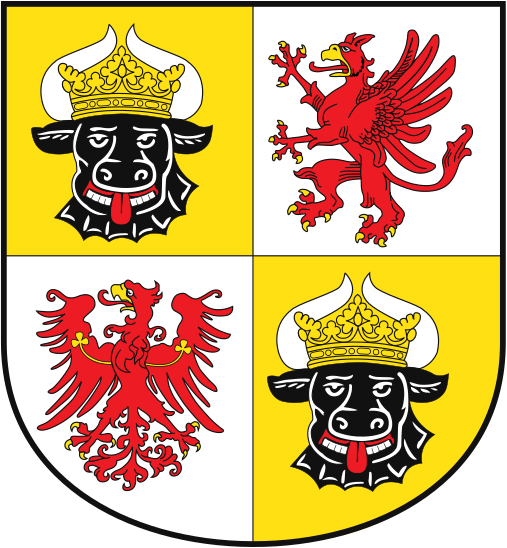
Explanation
Picture 2 shows the coat of arms of the Freistaat (Free State) of Bayern (Bavaria): white and blue lozenges, small diagonal diamonds, with a crown on top. The lozenges have been the symbol of Bayern for centuries.
- „Bild 1“: These are the three black lions on gold of Baden-Württemberg.
- „Bild 3“: This is the coat of arms of Sachsen-Anhalt (Saxony-Anhalt): black and gold stripes with a green crown band at the top, a black bear on a red wall at the bottom.
- „Bild 4“: This is Mecklenburg-Vorpommern, with black bull heads, a red griffin and a red eagle.
Question bayern-02
Welches ist ein Landkreis in Bayern?
- Prignitz
- Rhein-Sieg-Kreis
- Nordfriesland
- Altötting(correct answer)
Explanation
Altötting is a district in the south-east of Bayern (Bavaria), near the border with Austria. The town of the same name is a well-known Catholic place of pilgrimage, a place believers travel to for prayer.
- „Prignitz“: This district is in Brandenburg, in the north-west of the state.
- „Rhein-Sieg-Kreis“: This district is in Nordrhein-Westfalen (North Rhine-Westphalia), near Bonn.
- „Nordfriesland“: This district is in the far north, in Schleswig-Holstein on the North Sea.
Question bayern-03
Für wie viele Jahre wird der Landtag in Bayern gewählt?
- 3
- 4
- 5(correct answer)
- 6
Explanation
The Bavarian constitution says that the Landtag (state parliament) is elected every 5 years. This is the case in almost all federal states.
- Nr. 3 and Nr. 6: No Landtag in Germany has such a short or such a long term.
- Nr. 4: The Bundestag (federal parliament) is elected every 4 years, not the Bavarian Landtag.
Question bayern-04
Ab welchem Alter darf man in Bayern bei Kommunalwahlen wählen?
- 14
- 16
- 18(correct answer)
- 20
Explanation
In Bayern (Bavaria), you can only vote in local elections from the age of 18, for example for the municipal council or the mayor. Each federal state sets the voting age for local elections itself, and Bayern has kept it at 18.
- Nr. 14: In no federal state can you vote this young.
- Nr. 16: Some other federal states let you vote at 16, for example Baden-Württemberg. In Bayern it is 18.
- Nr. 20: This voting age does not exist for any election in Germany.
Question bayern-05
Welche Farben hat die Landesflagge von Bayern?
- blau-weiß-rot
- weiß-blau(correct answer)
- grün-weiß-rot
- schwarz-gelb
Explanation
The state flag of Bayern (Bavaria) has the colours white and blue. You often see it as a white and blue lozenge pattern, with small diagonal diamonds. These lozenges were the symbol of the Wittelsbach family, who ruled Bayern for over 700 years.
- „blau-weiß-rot“: These are the colours of the flag of Schleswig-Holstein.
- „grün-weiß-rot“: No German federal state has these colours in its flag.
- „schwarz-gelb“: Black and yellow (gold) are the colours of Baden-Württemberg.
Question bayern-06
Wo können Sie sich in Bayern über politische Themen informieren?
- beim Ordnungsamt der Gemeinde
- bei der Landeszentrale für politische Bildung(correct answer)
- bei der Verbraucherzentrale
- bei den Kirchen
Explanation
The Landeszentrale für politische Bildung (state agency for civic education) offers information about politics, elections and democracy, often free of charge. It is non-partisan, so it supports no party. In Bayern (Bavaria) it is based in Munich.
- „beim Ordnungsamt der Gemeinde“: The Ordnungsamt (public order office) looks after safety and order in the municipality, for example with noise or illegal parking.
- „bei der Verbraucherzentrale“: The Verbraucherzentrale (consumer advice centre) gives advice on shopping, contracts and problems with companies.
- „bei den Kirchen“: The churches are religious communities. They inform about faith, not neutrally about politics.
Question bayern-07
Die Landeshauptstadt von Bayern heißt …
- Ingolstadt.
- Regensburg.
- Nürnberg.
- München.(correct answer)
Explanation
Munich is the seat of the Bavarian state government and of the Landtag (state parliament) of Bayern (Bavaria). Munich is also the largest city in the state.
- „Ingolstadt.“ and „Regensburg.“: These cities are in Bayern, but the state government does not sit there.
- „Nürnberg.“: The second largest city in Bayern, but not the state capital.
Question bayern-08
Welches Bundesland ist Bayern?
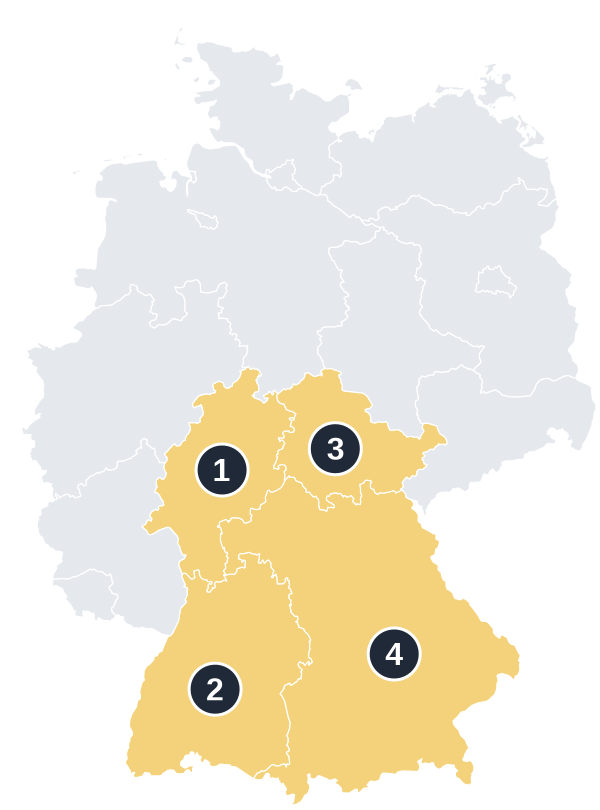
- 1
- 2
- 3
- 4(correct answer)
Explanation
Bayern (Bavaria) is the largest federal state and lies in the south-east of Germany. It borders Austria and the Czech Republic. On the map this is number 4.
- Nr. 1: This is Hessen (Hesse). It lies north-west of Bayern.
- Nr. 2: This is Baden-Württemberg, west of Bayern.
- Nr. 3: This is Thüringen (Thuringia), a smaller state north of Bayern.
Question bayern-09
Wie nennt man die Regierungschefin/den Regierungschef in Bayern?
- Erste Ministerin/Erster Minister
- Premierministerin/Premierminister
- Bürgermeisterin/Bürgermeister
- Ministerpräsidentin/Ministerpräsident(correct answer)
Explanation
In Bayern (Bavaria), the head of the state government is called Ministerpräsident (minister-president). The office has this name in all federal states except Berlin, Hamburg and Bremen. The Landtag (state parliament) elects this person.
- „Erste Ministerin/Erster Minister“ and „Premierministerin/Premierminister“: These titles do not exist in the German federal states.
- „Bürgermeisterin/Bürgermeister“: A Bürgermeister (mayor) runs a town or municipality, not a whole federal state like Bayern.
Question bayern-10
Welche Ministerin/welchen Minister hat Bayern nicht?
- Justizministerin/Justizminister
- Außenministerin/Außenminister(correct answer)
- Finanzministerin/Finanzminister
- Innenministerin/Innenminister
Explanation
Under the Grundgesetz (Basic Law), foreign policy is a matter for the federal government. So there is only one foreign minister for all of Germany, in Berlin. Bayern (Bavaria) does not have this office either.
- „Justizministerin/Justizminister“: This really exists. Bayern is responsible for its courts and prisons.
- „Finanzministerin/Finanzminister“: This really exists. The finance ministry manages the state's money, for example for schools and the police.
- „Innenministerin/Innenminister“: This really exists. In Germany the police is mainly a matter for the states, so every state has an interior ministry.